HU-MFA Expedition

The Art and Discovery of Idu's Tomb
Joseph Lindon Smith and the HU–MFA Expedition
Throughout his life, HMANE founder David Gordon Lyon (1852–1935) advocated archaeological exploration as a way to gain new knowledge about ancient cultures and to collect objects for exhibition. The Harvard University–Boston Museum of Fine Arts Expedition ran successfully on the Giza Plateau and at other sites in Egypt and Sudan from 1905 through 1947, directed by Lyon’s former student, Assyriologist-turned-Egyptologist George A. Reisner (1867–1942).


Fig. 2-1. George Reisner (at left, with vest and pith helmet) working at the Samaria, Palestine excavations, 1909–1910. Courtesy HMANE
Fig. 2-2. George Reisner (in suit) faces the camera from the wall of the Menkaure Valley Temple at Giza, December 30, 1909. Courtesy Museum of Fine Arts, Boston.
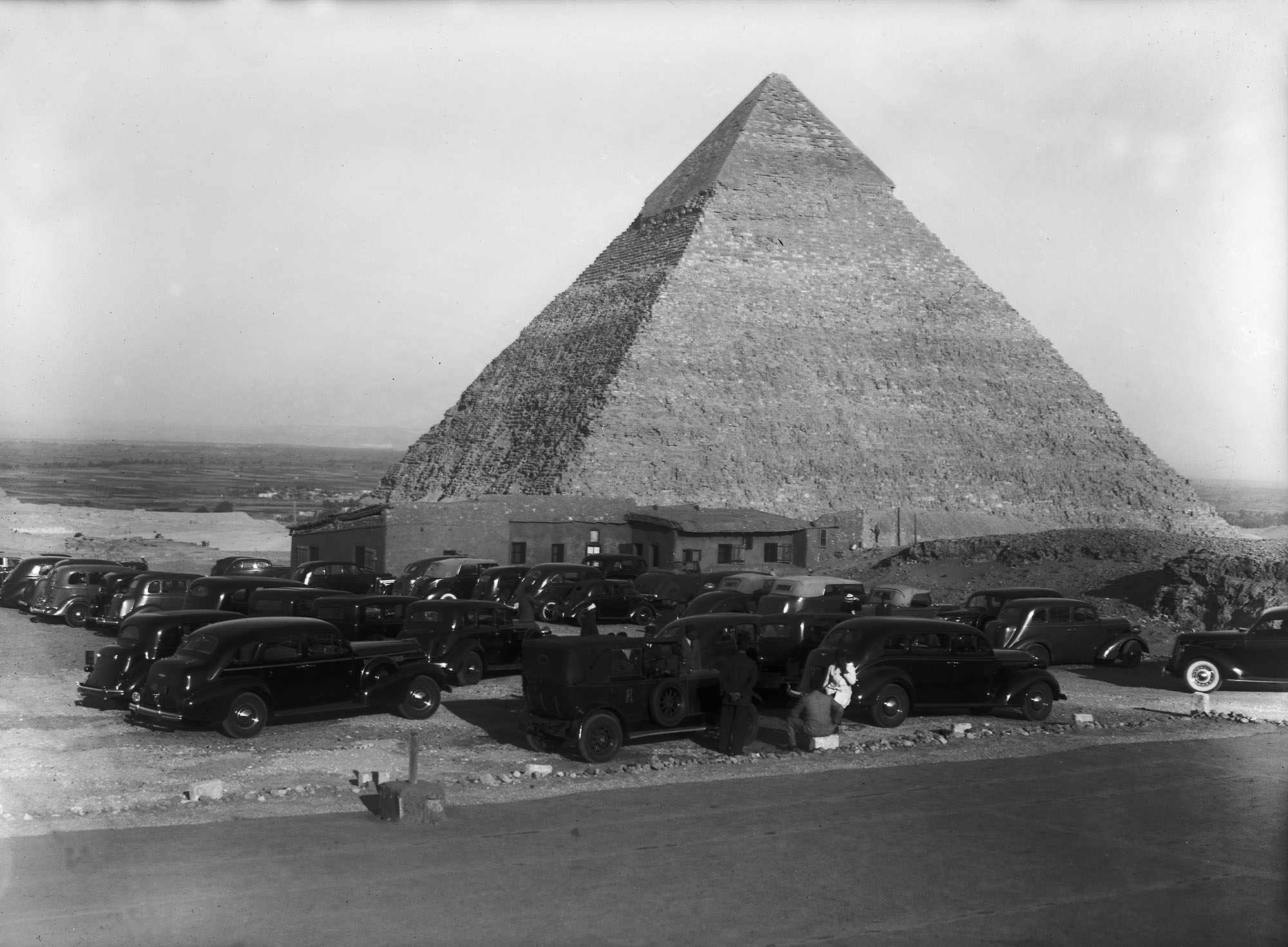
Fig. 2-3. George Reisner (at right, wearing cap) surveys the Menkaure Valley Temple excavations at Giza, looking west towards the Menkaure Pyramid, January 11, 1910. Courtesy Museum of Fine Arts, Boston.
Fig. 2-4. George Reisner (at center left, wearing hat) surveys the Menkaure Valley Temple excavations at Giza, looking north towards the Great Pyramid of Khufu, February 13, 1910. Courtesy Museum of Fine Arts, Boston.
Fig. 2-5. George Reisner excavates cylinder sheaths in Pyramid 8 of King Aspelta at Nuri, Sudan, while Dows Dunham and two unidentified Egyptians look on, April 20, 1916.
Fig. 2-6. Eastern Cemetery excavations at Giza, looking south, with George Reisner (in white pants) and William Stevenson Smith conversing at right, December 31, 1930.
Two of George and his wife Mary (1870–1950) Reisner’s closest friends were the American painter, Joseph Lindon Smith (1863–1950), and his wife Corinna (1876–1965), who was fluent in Arabic. After training at the School of the Museum of Fine Arts, Boston, and in Paris at the Académie Julian, Smith abandoned being a portraitist and found his calling in painting ancient sites and monuments. Although Smith traveled to—and painted—sites all over the Old and New Worlds over a long career, he returned almost every year to Egypt, joining Reisner at the “Harvard Camp” dig house headquarters west of the famous Giza Pyramids, or wherever Reisner happened to be excavating in Egypt or Sudan. Reisner told him: “You’ve accomplished the impossible. Each painting is an archaeological record correct in details, but beautiful as a picture.” These images became an important type of documentation, since back then there was no color photography in archaeology.
Joseph Lindon Smith at Work

Fig. 3-1. Undated photo of Joseph Lindon Smith painting near the Sphinx at Giza, looking west. Courtesy Dublin Historical Society.
Fig. 3-2. Joseph Lindon Smith painting atop Pyramid Beg. N 4 at Meroe, Sudan, February 20, 1921. Courtesy Museum of Fine Arts, Boston.
Fig. 3-3. Joseph Lindon Smith painting in the temple of Semna fort, Sudan, February, 1930. Courtesy Dublin Historical Society.
Fig. 3-4. Joseph Lindon Smith painting in Kumma fort, Sudan, February, 1930. Courtesy Dublin Historical Society.
Fig. 3-5. Joseph Lindon Smith paints the embrace of King Thutmose III and the god Amun-Ra in the temple of Karnak. Archives of American Art.
Fig. 3-6. Joseph Lindon Smith paints in the temple of Seti I at Abydos, probably January 1938. Archives of American Art.
Fig. 3-7. “Boston Artist with Sense of Humor Tells ‘Good Stories’ on Himself,” The Boston Globe, January 11, 1939.
In the 1930s, Reisner put on a show each year at “Harvard Camp” of Smith’s recent work, including a reception for well over 100 guests.
Reisner also made sure the Museum of Fine Arts, Boston (MFA) acquired as many of Smith’s paintings as possible. These paintings adorned many of the MFA’s gallery walls, to enhance the collection of antiquities Reisner was sending back to Boston, with the Egyptian Government’s permission, as stated in his excavation contract, (the other half of Reisner’s finds went to the Cairo Museum, while Nubian objects went to Khartoum). Today the MFA owns more than a hundred of Smith’s paintings, and many of them can currently be seen on long-term loan at the Fitchburg Art Museum, northwest of Boston. The Harvard Art Museums also have a rich collection of Smith’s work, but only a few of these show ancient Egyptian subjects. Many other collectors, such as Boston’s Isabella Stewart Gardner (1840–1924), have also acquired Smith’s paintings over the years.
Joseph Lindon Smith's Work at Fitchburg Art Museum

Fig. 5-1. Joseph Lindon Smith paintings on view in the Fitchburg Art Museum. Photo by Peter Der Manuelian.
Fig. 5-2. Joseph Lindon Smith paintings on view in the Fitchburg Art Museum. Photo by Peter Der Manuelian.
Fig. 5-3. Joseph Lindon Smith paintings on view in the Fitchburg Art Museum. Photo by Peter Der Manuelian.
Fig. 5-4. Joseph Lindon Smith paintings on view in the Fitchburg Art Museum. Photo by Peter Der Manuelian.
Fig. 5-5. Joseph Lindon Smith paintings on view in the Fitchburg Art Museum. Photo by Peter Der Manuelian.
The Tomb of Idu, G 7102, at Giza
In January of 1925, the Harvard University–Boston Museum of Fine Arts Expedition discovered a small underground tomb chapel, just east of the Great Pyramid at Giza. They labeled it tomb G 7102. A series of black-and-white, large-format photographs, shot on glass plate negatives by Expedition photographer Mohammedani Ibrahim, documents every stage of the excavation, as well as the wall decoration. Over the entrance was a magnificent architrave, inscribed with nine lines of detailed hieroglyphs and a standing figure of the tomb owner at the right. The text lists his name and titles, a brief biography, and an offering formula to make sure he had everything needed for a successful afterlife.

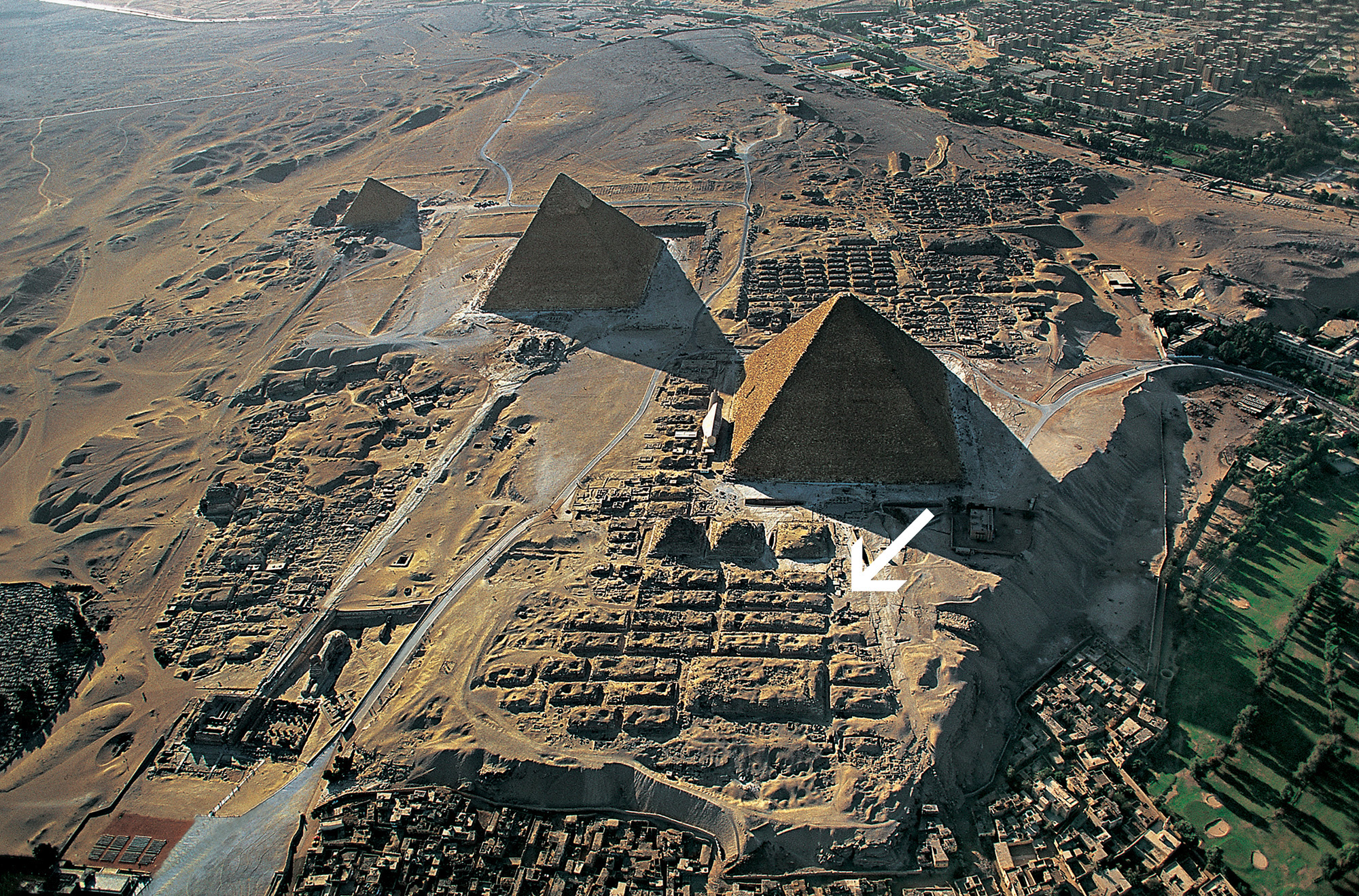

Fig. 8-1. The tomb of Idu appearing, looking south, January 10, 1935.
Fig. 8-2. The tomb of Idu appearing, looking south, January 10, 1935.
Fig. 8-3. The tomb of Idu, with entrance architrave cleared, looking south, January 10, 1935.
Fig. 8-4. Entrance to the tomb of Idu, looking south, January 12, 1935.
Fig. 8-5. Architrave over the entrance to the tomb of Idu, March 21, 1925.
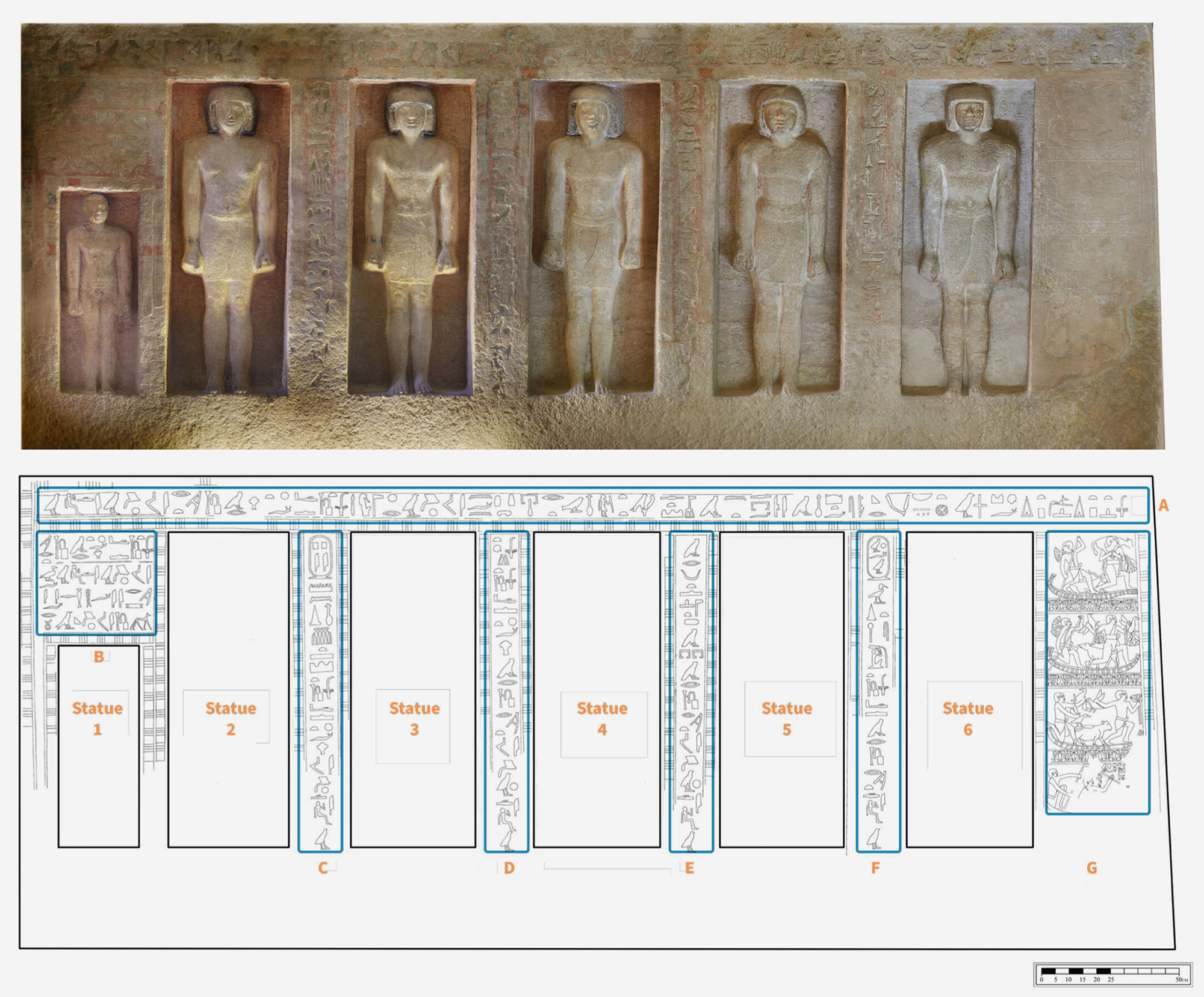
Tomb G 7102 belonged to a high official named Idu and dated to the Sixth Dynasty of the Old Kingdom, or Pyramid Age, in the reign of King Pepi I or later (about 2390–2361 BCE). The superstructure (the parts of the tomb above ground) had long since disappeared, but the underground chapel, carved in the limestone bedrock, preserved many scenes on its four walls. There was plenty of surviving color, and the ancient artists even carved six statues into niches on the east wall. On the west wall, the upper half of Idu’s figure seems to rise up out of a “false door” niche that magically connected to the Netherworld. Idu stretches his arms outwards to receive food and drink offerings for his spirit from the (ancient Egyptian) visitors to his tomb. The hieroglyphs list offering spells, his name, and his job titles, such as “royal document scribe.”
Interior of Idu's Chapel

Fig. 10-1. Underground tomb chapel of Idu, looking south. Image courtesy White Star Publishers.
Fig. 10-2. Left to right: Image of Idu, emerging from his “false door,” looking west. Image courtesy White Star Publishers; Statue on the east wall of the underground tomb chapel of Idu. Courtesy White Star Publishers; West wall offering scene of Idu. Courtesy White Star Publishers.
Fig. 10-3. Egyptian tourists visit the underground tomb chapel of Idu, May 15, 2021. Image courtesy of Marleen De Meyer.
By the time Joseph Lindon Smith and his daughter Frances arrived at Giza, two months after the discovery of Idu’s tomb, they were ready to document the wonderful scenes and colors with oil on canvas paintings. We can even quote some references to this work from Smith’s unpublished diary notebook called “1925. Tiney and Pops. Egypt,” now in the Dublin Historical Society, Dublin, New Hampshire (Smith referred to daughter Frances as “Tiney”):
March 29, 1925: We were shown the unique and charming tomb of [Idu] and Tiney and I began work there in the afternoon.
March 30, 1925: Worked all day in the little tomb [of Idu] and very happy both of us to be painting again—the light in the tomb is fine all day up to 5.
April 1, 1925: Tiney and I worked in our little tomb all the morning and in the afternoon I began a study of Enkh Haff [orange bust of Ankh-haf from tomb G 7510, MFA 27.442]—profile—he is most interesting to do.
April 6th, 1925: I finished my study of the “Bachsheesh” man [Idu] and began one of his little son at the left of the doorway. Tiney’s picture comes on well.…
Smith created at least five Idu paintings in March–April 1925, while Frances contributed two of her own. The painting acquired by the HMANE in 2024 shows the west wall false door with Idu’s statue emerging. This is the painting Smith refers to in the final diary entry above as the “Bachsheesh” man. “Baksheesh” in Arabic means a “tip” or “bribe,” and Smith must have felt that Idu’s statue, with his arms outstretched, was asking for something (which he was! Idu wanted offerings for his spirit). The year 2025 marked the 100th anniversary of Smith’s creation of this painting.

Joseph Lindon Smith (American, 1863–1950)
Egypt (Giza, tomb of Idu, G 7102)
Dynasty 6, 2338–2170 BC
Oil on canvas
HMANE 2024.1.1
Paintings by Smith and His Daughter Frances G. Smith

Fig. 12-1. Left to right: West wall offering scene of Idu; oil on canvas painting by Joseph Lindon Smith, MFA 30.458. Photo by Peter Der Manuelian; “False door” statue from the tomb of Idu; oil on canvas painting by Joseph Lindon Smith, MFA 25.511. Photo by Peter Der Manuelian.
Fig. 12-2. Left to right: Engaged statue in east wall of tomb of Idu, oil on canvas painting by Joseph Lindon Smith, MFA 25.509, begun on April 6, 1925. Photo by Peter Der Manuelian; Interior scene to the right (east) of entrance to tomb chapel of Idu, oil on canvas painting by Joseph Lindon Smith, MFA 36.267. Photo by Peter Der Manuelian; Interior view of the tomb chapel of Idu, looking north, oil on canvas painting by Frances G. Smith, MFA 25.512. Photo by Peter Der Manuelian; Engaged statue on the east wall of the tomb chapel of Idu, oil on canvas painting by Frances G. Smith, MFA 25.510. Photo by Peter Der Manuelian.
Although they are not as well-known as paintings by other “Egyptological artists” such as Nina and Norman de Garis Davies, or Charles K. Wilkinson (whose paintings are on view in the Metropolitan Museum of Art, New York), Smith’s paintings have proven valuable to scholars for preserving the colors, look and feel of these Egyptian monuments as they appeared in the first half of the twentieth century. Since that time, many colors have faded, inscriptions are no longer readable, or climate change has taken its toll on the ancient Egyptian monuments. Although sometimes impressionistic in his brushstrokes, Smith nevertheless produced accurate and aesthetic works of art, all freehand, that capture the essence of Egyptian two- and three-dimensional works of art.
We are pleased to be able to add this new Joseph Lindon Smith painting of Idu to our collection for all visitors to enjoy, both in our gallery and online via this website.
The Modern Documentation of the Tomb
Long after the deaths of George Reisner at the Giza Pyramids in 1942, and of Joseph Lindon Smith in Dublin, New Hampshire in 1950, curators at the Museum of Fine Arts, Boston, returned to Giza to produce excavation reports on the tombs that Reisner did not live long enough to publish. MFA curator William Kelly Simpson (1928–2017) published the tomb of Idu in the MFA’s “Giza Mastabas Series” in 1976. This traditional academic publication describes the tomb, its owner and his family, presents the wall decoration, translates all the texts, and summarizes Reisner’s original excavation.
Nowadays we have many new approaches to creating documentation of ancient Egyptian monuments, both for scholarly study and for a wider audience. Due to a successful collaboration between the Giza Project at Harvard and the Epigraphic Survey of the Oriental Institute, a digital version of the Simpson book is available now for the first time, restructured as an online publication. Far more than a simple PDF scan of the original 1976 publication, this experiment in digital scholarship includes the tight integration of image and text. While respecting the book’s structure, we supplemented the written material with as many visuals as possible, even beyond what appeared in the original book. There are previously unpublished archival photographs, 3D renderings, clickable maps, zoomable drawings, and several wall maps embedded in the text that were explicitly created for the digital re-release.
Orthophotos—digital images that combine the characteristics of a photograph with the geometric qualities of a map—can help us visualize entire stretches of long walls, and even measure them accurately.
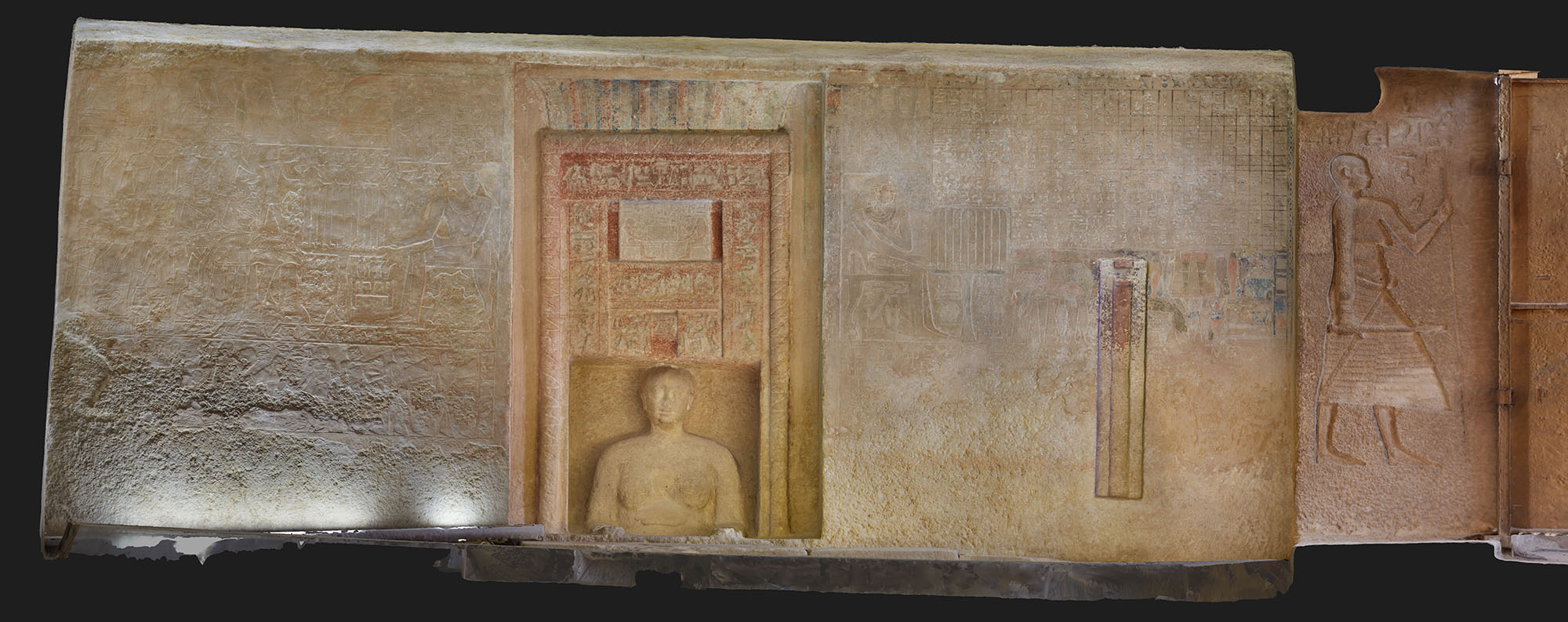
Virtual visitors to the tomb of Idu can also consult the archaeological documentation gathered on Harvard’s Giza Project website. An interactive 3D model of the tomb chapel is also online. And finally, we present a guided, narrated tour of some highlights within the tomb, restoring some of the original wall colors. This three-minute video was generously provided by the makers of the iPad app “The Pyramids,” available for purchase (with much more Giza content) on the Apple App Store.
Epigraphy is the creation of facsimile line drawings of scenes and inscriptions. A simple line drawing example of Idu’s false door texts, the same scene painted in oil by Joseph Lindon Smith, was produced for the 1976 scholarly publication.
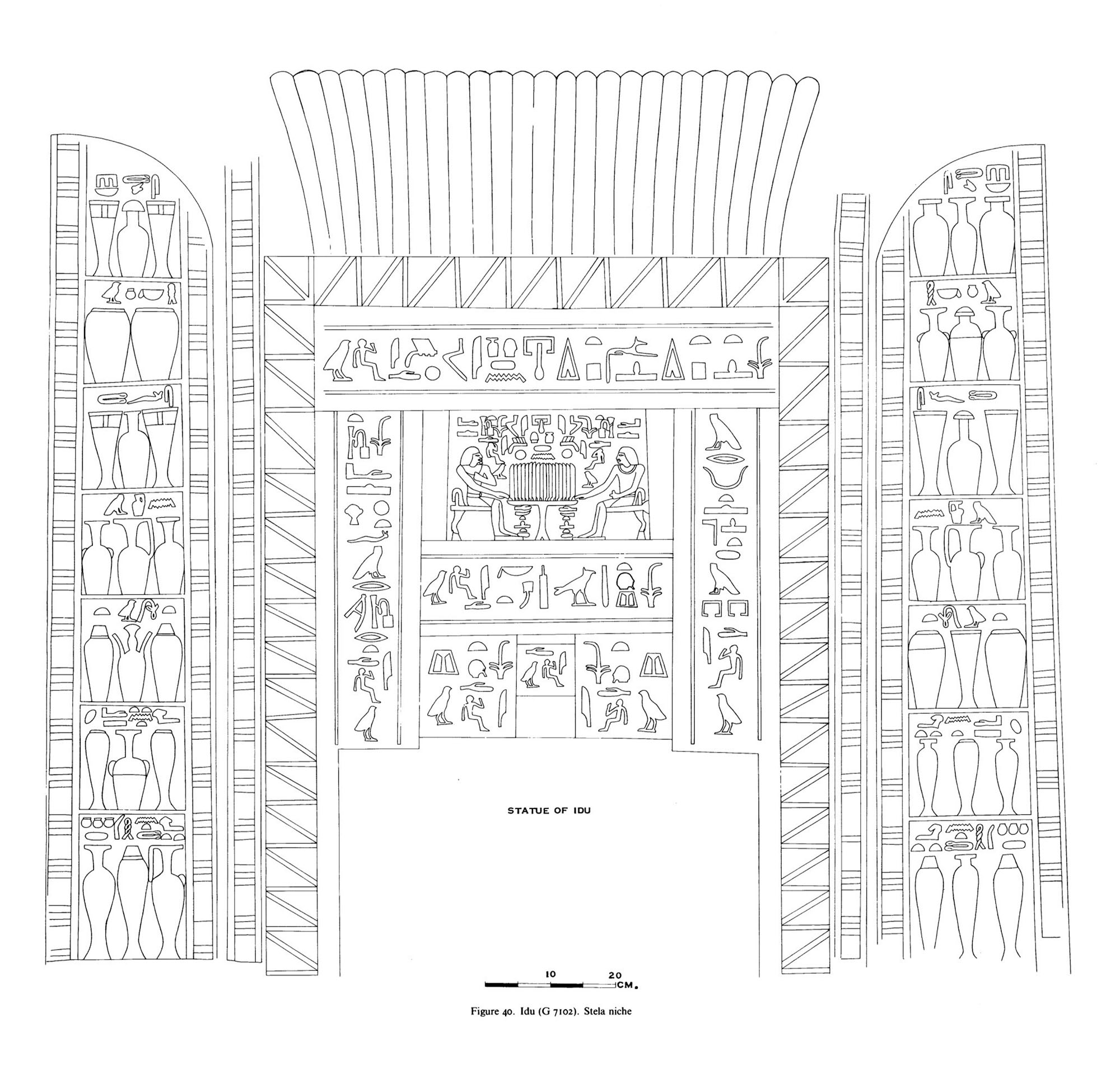
In recent years, epigraphy has moved from pen-and-ink tracing and inking to “digital epigraphy,” with the help of drawing tablets, iPads, and graphics apps such as Adobe Photoshop, Illustrator, and Procreate. The best website to explore these technologies is “Digital Epigraphy.”